What I wrote, taught, and published in 2025
I look back at my writing, teaching, publishing, and presenting from 2025. Also, looking ahead to this next year of reflection and exploration.
– 11 min read
I look back at my writing, teaching, publishing, and presenting from 2025. Also, looking ahead to this next year of reflection and exploration.
You thought that since the holidays were over you were done with all those year end roundup emails? Au contraire, mon frère – I have another hearty helping of year end summary for you to enjoy.
Every year I look back at the major happenings for the year, whether they were writing, teaching, publishing, or presenting, in order to bring folks up to speed on what I've been doing. If you see anything here that piques your interest, please don't hesitate to shoot me an email using matt[at]samsara.media or my Contact page to reach out.
And as for what I'm thinking about as we head into this new year, I'll be sending out a post or two about that in the coming weeks. Right now I'm in a season of discerning what my goals are for my online intellectual work. This piece focuses on taking stock of this past year, although I drop some comments which give you a glimpse into how I'm thinking about my work going forward. Thanks for reading!
If we simply look at my writing this year from the perspective of raw numbers, I find that I published 23 pieces, 16 on Substack and 7 on Samsara Diagnostics (I've got a number of unfinished drafts too).
I'm also happy to say that email list more than doubled this year, and I also gained 6 paid subscribers (and even lost a few along the way!). The vast majority of that growth seems to have been from Substack, both people sharing my work on Notes or through Substack's native discovery mechanisms. I have found my writing at Substack to be fruitful for my sharpening my own thinking, plus it offers better reader feedback mechanisms, such as likes, comments, and Notes.
Nonetheless, I've made the decision to pivot back towards my private website, where I will be gathering my projects Samsara Diagnostics and Moloch Theory under one heading. Over the coming months, I'll be re-branding this website to just be my name 'Matthew Stanley,' but I will be keeping some visual separation between the two projects because they represent distinct lines of thought.
In 2025 my frequency of publishing pieces was down overall compared to the past two years, but I'm nonplussed by this for at least two reasons:
I've also realized that my productivity in 2023 and 2024 was an outpouring of energy which had been building for years, likely ever since I departed college to start my life outside of the academy. After I wrangled dump truck drivers, reported software bugs, and poured over data about asphalt at my 9 to 5 job, I would head to coffee shops to write about Shusaku Endo or to read Slavoj Žižek.
I almost completed a masters in philosophy and psychoanalysis at the Global Center for Advanced Studies (gcas.ie) from 2020 to 2022, but, as seems to be a pattern with me, I dropped out before I could finish my dissertation. However, much of that dissertation was repurposed into the early posts here at Samsara Diagnostics, helping me to accelerate into my work in early 2023. That worked out well, because the consistency of posting propelled me into conversation with other people thinking about similar ideas, which then stimulated more writing.
But it feels like that creative fount is starting to dry up. I'm not as motivated by elaborating the finer points of continental philosophy or psychoanalytic theory, even as I continue to enjoy these things immensely. I'm realizing that life is often short, and time is utterly precious, so am I using mine well? That remains to be seen, but I think that just continuing to ask the question is a good starting point.
Judging by total views and total likes, these were my most popular pieces in 2025:
The most important piece on Samsara Diagnostics this year was by far "Losing your field and becoming illegible" which was circulated amongst some folks in the Incite Seminars community, leading to a virtual event where a number of us gathered to discuss the difficulties of pursuing intellectual work within the academy today. I'm grateful to those who took the time to ask me questions to understand my situation further, and offered advice to me about how to proceed.
More than just intellectual work though, the question of the entanglement of intellectual work, community, and identity all feel central to what I've been struggling with for about half my life, and I'm trying to confront those questions more head on for myself by making them explicit.
Lastly, I just want to mention the piece "Practical Freedom," which felt like a next step in understanding how to formulate the problem I'm working on in Moloch Theory, that of how "freedom" itself is both our central possibility and problem within our modern social, political, and economic environment. You'll see me continue to weave themes from that work as I write and explore more this year.
Heading into 2025, I had planned to design and launch a "critical bureaucratic studies" course online which would explore the main themes of my Moloch Theory project – the critique of the professional-managerial class, the entanglement of science, governance, and capital, the capitalist colonization of vital human activities, the distortion of learning perpetrated by schooling, and much more.
While I ultimately realized that the project was much too large to properly explore in one class, which is perhaps somewhat an issue with my failure to properly scope the research, much of my work this year nonetheless tried to keep doggedly exploring the elements which would compose such a research program. I realized that I had a number of guiding intuitions, conceptual frames, and key texts I was working with, and I ended up exploring those through my writing at Moloch Theory, justified in my mind as preparation for this hypothetical future course.
While my "critical bureaucratic studies" course remains a distant hypothetical, I'm nonetheless grateful to the Incite Seminars community, and all the wonderful students who turned out, for allowing me to teach two seminars this year which explored some key aspects of the "critical bureaucratic studies" research program.
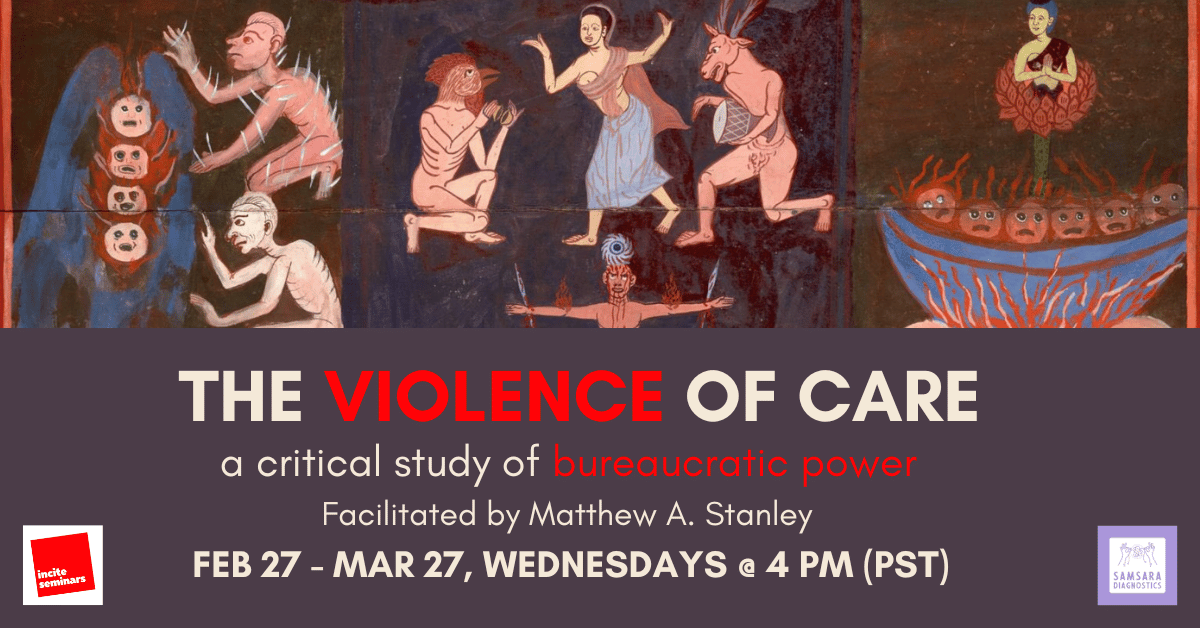
In February 2025, I taught "The Violence of Care: A Critical Inquiry into Bureaucratic Power" as an attempt at a micro-version of the course, to see what felt most important about the project and how others might receive its ideas. The seminar had learners reading Michel Foucault, Ivan Illich, Bruno Rizzi, James Burnham, David Graeber, and James C. Scott, looking at the ways that bureaucratic governing apparatuses change our individual and communal perception, expand through the production of harmful outcomes, and leave us more dis-abled precisely through their efforts to help us.
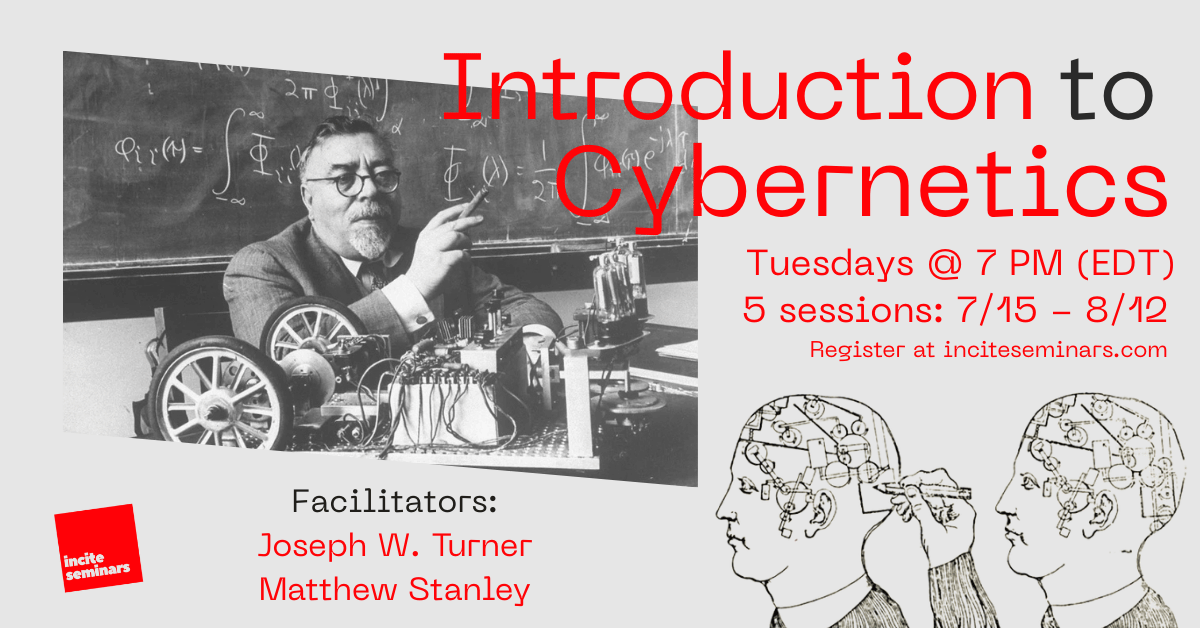
For five weeks from July to August, I enjoyed co-teaching "An Introduction to Cybernetics" with Joseph W. Turner, a friend I had met through Incite Seminar. Joseph is working on a PhD at UW-Madison, and had spent quite a bit of time studying things I was also interested in – cybernetics, Japanese philosophy, Agamben, anarchism – so we decided to team up and teach a course together. I had never taught with another person before, but the experiment was a resounding success, and I think the combination of both our approaches added a rich depth to the learning experience.
This year also afforded the opportunity for me to deliver presentations in a few academic venues, both digitally and in-person.
This year was also filled with opportunities to include my work alongside the writings of other great thinkers in some unique collections.
Whether you've just found my work or you've been following for years, I'm delighted that you're here. I fully trust that whatever is of most value to you in my work will find you when you most need it.
This year feels to me like a time for reflecting, taking stock, and looking forward to build on what has already come before. You can expect from me another book published, some essays trying to synthesize my past work, as well as guides about where to start or dive back in, as well as charting new directions (the "wild professionals" motif feels particularly potent to me).
I would be remiss if I didn't offer you the chance to upgrade from a free subscription to a paid subscription. My family and I are not destitute by any means (God is always gracious to us), but everyone who gives even a little bit of money sends a strong signal about whether I'm on the right track or not. It encourages me to keep going, to keep putting independent scholarship out into the world. I hope you'll partner with me this year on this journey of exploration!