Welcome to new subscribers! We've had a number of new subscribers join us over the past couple of weeks, so I'd like to take a moment to welcome you all by providing a brief orientation, and a recap of some recent content here at Samsara Diagnostics. 📎If you still haven& Matthew A. Stanley
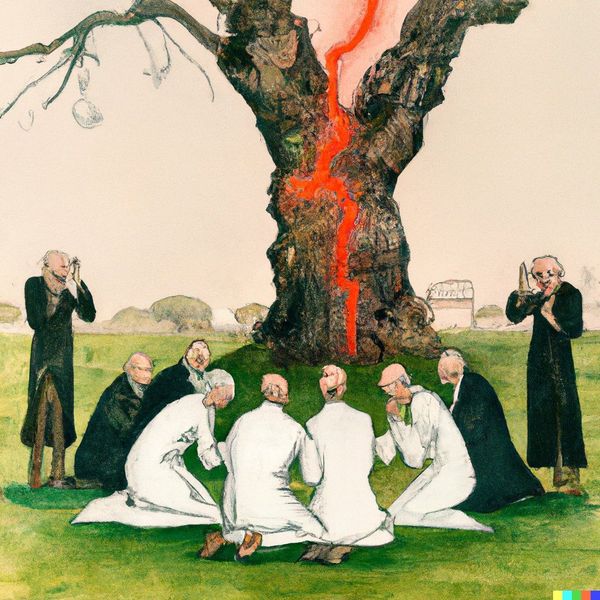
Narrative natures - A dialectical excursus on the (im)mortality of Jesus "God is whoever raised Jesus from the dead, having before raised Israel from Egypt." – Robert Jenson, Systematic Theology, Vol 1 (63) Earlier this week we took a look at Žižek's debate with Milbank about the superiority of dialectic to paradox. Žižek argues that the figure of Matthew A. Stanley • Theology
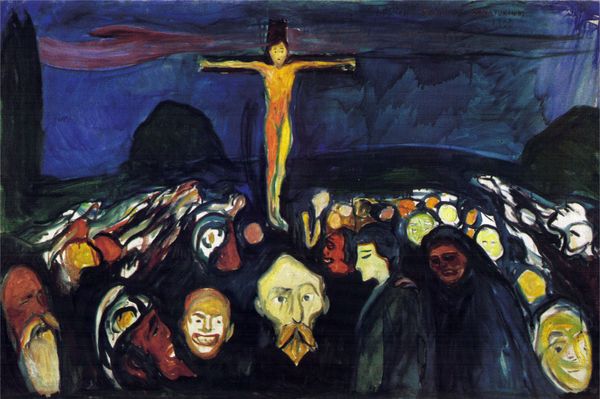
"The Crucifixion" by Edvard Munch (1900) The contingent third term, or, Žižek against Milbank on paradox In The Monstrosity of Christ, Slavoj Žižek and John Milbank debate the path forward after the collapse of secular reason. As they try to mark out a post-secular way, they characterize the difference between their positions as the difference between dialectic and paradox. Žižek and Milbank on Mediation Zizek, Matthew A. Stanley • Philosophy
I'm offering a free PDF about Heidegger and the Kyoto School If we can think about the religious journey as a diagnosis and prescription for the human condition, we can begin to see what hangs on how we answer the question of what sort of problem a human being presents to themselves and their world. We can't have a Matthew A. Stanley • Philosophy
Chitoge with Shaft's signature throwing the head back The Myth of Absolute Origin, or, watching Nisekoi with Nietzsche I recently wrote a piece about the psychological trap which the childhood friend trope in anime represents for the protagonist (and the viewer!), but I want to keep exploring that line of inquiry by examining two other tropes which are intimately intertwined with the trope of the childhood friend -- " Matthew A. Stanley • Philosophy
Photo by Alexander Andrews / Unsplash How object permanence underlies our experience of self What do we make of the human love affair with the visual realm? As a species, we suffer from a fixation — a veritable obsession with — the world of images. Jean Piaget famously postulated that, early on in their life, a child develops what is called 'object permanence.' Object Matthew A. Stanley • Psychoanalysis