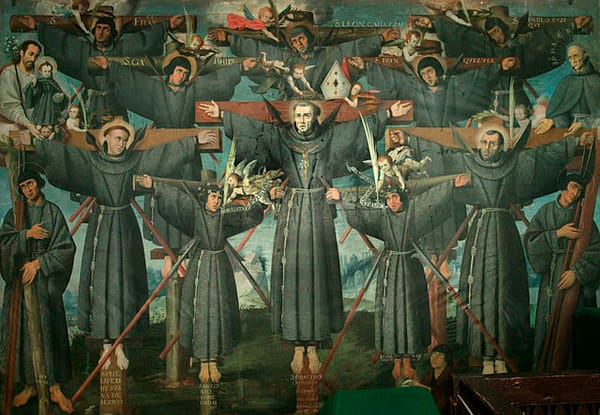
Martyrs in Nagasaki Podcast: Emancipation and the (im)possibility of nationalism I've been hard at work on my book, and I managed to finish a rough draft of chapter 3 during April. Now I'm moving backwards a bit to work on chapter 2 during May. So, I'll be reading a lot of Japanese history this Matthew A. Stanley • Buddhism
The Therapeutist by Rene Magritte (1937) Willed ignorance - against knowledge theories of suffering This essay continues our series on the philosophical problem posed by the emergence of self-destructive behaviors in human beings. There seems to be two moments within the event of understanding. In the first moment, the knower apprehends the thing being known. However, this moment is followed by a second in Matthew A. Stanley • Philosophy
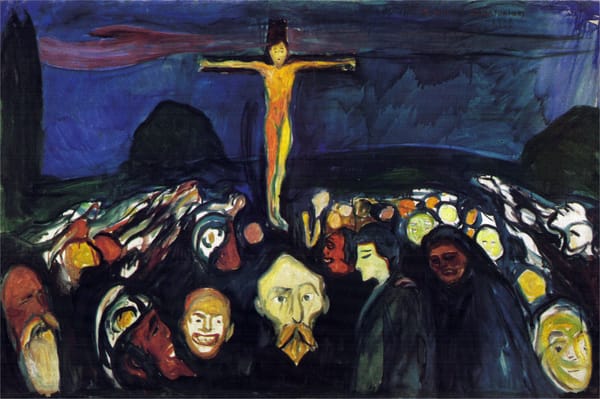
"The Crucifixion" by Edvard Munch (1900) The contingent third term, or, Žižek against Milbank on paradox In The Monstrosity of Christ, Slavoj Žižek and John Milbank debate the path forward after the collapse of secular reason. As they try to mark out a post-secular way, they characterize the difference between their positions as the difference between dialectic and paradox. Žižek and Milbank on Mediation Zizek, ever Matthew A. Stanley • Philosophy
The pathologies of knowledge, or hard lessons from cutting my teeth on Calvinism Protestant Christianity in America consists of a veritable alphabet soup of denominations, so saying that I grew up in the OPC probably means nothing to you. If it does, lol wow I’m sorry and I probably know you. What if I also told you that my Christian high school Matthew A. Stanley • Theology
What sort of problem is a human? I was at work on a summer afternoon in 2018 when I received a surprising email. It was the editor from a journal I had forgotten I'd submitted a paper to. I only let that trip me up for a moment though, because he was saying that the Matthew A. Stanley • Theology
Fenestra Coeli Apertae by Johann Jakob Scheuchzer (1731) Christianity, Exoteric and Esoteric The esoteric/exoteric distinction The word esoteric possesses a certain mystique to the untrained ear, but has a technical meaning in the study of religions – an esoteric religion is one in which different things are taught to adherents at different levels of the faith. For example, scholars of Buddhism in Matthew A. Stanley • Theology